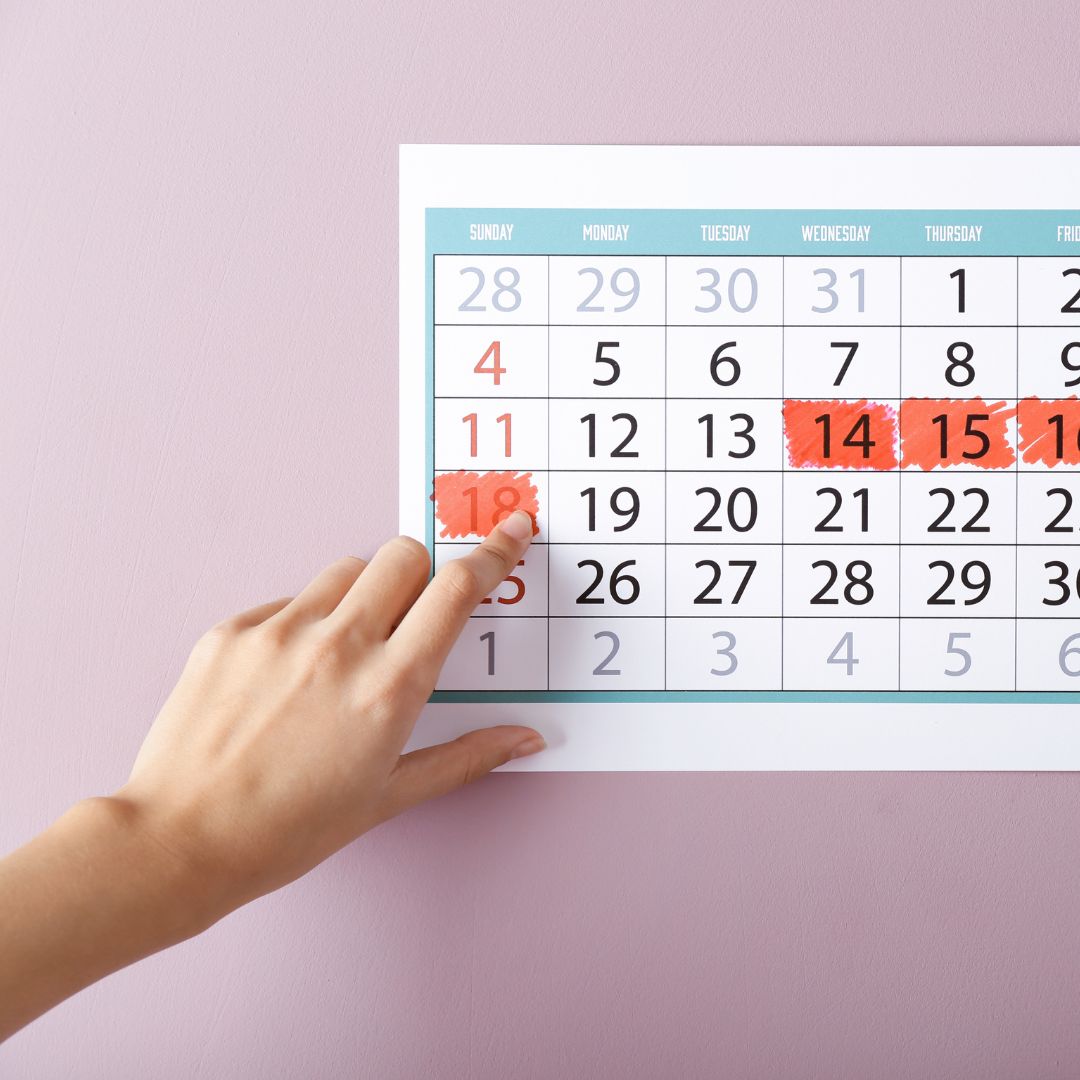



A normal cycle lasts 28 days, with ovulation on day 14. Is that right? Is that how yours is? No? Then we should look into that, because you're certainly not the only one whose cycle deviates significantly from this and probably varies slightly every month.
To provide guidance for research questions and medical examinations, reference ranges are stated and model cycles are designed. The 28-day model for an average menstrual cycle is exactly that kind of model. A nice practical value for calculations—but one that doesn't apply to most menstruating people at all. In fact, the cycle lasts 21–34 days for 60–80% of menstruating people. And a cycle of 21–45 days is even considered healthy. Including monthly fluctuations. So that's a very wide range. "Ovulation on day 14 of the cycle" is therefore also more of a generalized statement to determine the approximate cycle phase.
All right, but how do you know which cycle phase you're in? There are some clues for this, but they require careful observation of your body. With a little practice, you can then fairly accurately determine whether you are before or after ovulation. We'll summarize them for you.
What cycle phases are there?
The menstrual cycle starts on the first day of menstrual bleeding. During this time, the dead lining is expelled from the uterus and ends up in your period product along with blood and vaginal secretions. And yes, the unfertilized egg is in there somewhere too. Estrogen and progesterone levels are low during menstruation.
Do you actually have an overview of the different options for period products? We have dedicated an entire article to them, feel free to check it out!
Once the dead lining has been shed, FSH and estrogen levels increase, and the ovaries and uterus enter the proliferative phase. During this phase, follicles containing eggs mature in the ovary. The lining in the uterus also regenerates.
The steady increase in estrogen leads to a sharp rise in LH 24–36 hours before ovulation. At its peak, a fully mature egg is released from the follicle into the fallopian tube. Estrogen levels are also at their highest now and drop after ovulation. More information about ovulation can be found in the magazine.
The first three phases can be grouped together as the follicular phase.
The rest of the follicle remains in the ovary, where it transforms into the corpus luteum and produces progesterone. The effect of progesterone thickens the uterine lining. If fertilization of the egg does not occur over the next few days, the corpus luteum degenerates and progesterone levels drop. At the end of the corpus luteum (or luteal) phase, estrogen and progesterone levels reach a minimum and the supply to the uterine lining is cut off. It dies off and a new menstrual cycle begins.
How do I recognize the cycle phases?
Hormonal changes not only set processes in motion in the ovaries and uterus. The secretion of mucus at the cervix (cervical mucus), the shape of the cervix, and body temperature also change.
How do I recognize menstruation?
Menstruation is hard to miss, as a mixture of lining and blood is expelled over 2–7 days. At the end, it amounts to about 30–60 ml. If you bleed for significantly longer and feel that you are losing a lot of blood (e.g. if you have to change your period product every 1–2 hours), you should have it checked by a gynecologist.
If you want to debunk exciting myths about menstruation, feel free to check it out here.
How do I recognize the follicular phase?
The follicular phase follows menstruation directly. Cervical mucus is barely present during this time and is more clumpy, dry, and whitish. The cervix is closed and protrudes far into the vagina (so it lies far forward toward the vaginal opening). The closer it gets to ovulation, the more cervical mucus is released. It becomes increasingly moist and clear. Much more fluid, clear mucus indicates the start of the fertile window. The cervix also becomes increasingly soft now, and you may also notice that the opening enlarges. The cervix recedes further inward. The duration of the follicular phase varies.
How do I recognize ovulation?
Right around ovulation, the mucus is stretchy between the fingers, i.e. it pulls into threads. If you measure your basal body temperature regularly, you will now be able to detect an increase in temperature of 0.2–0.6°C due to ovulation. In some people, the temperature also drops slightly again just before ovulation due to high estrogen levels. The cervix is soft and open. Some menstruating people perceive ovulation as a pulling sensation in the abdominal area—the so-called Mittelschmerz. Others even have severe pain at this time. By the way, you can also determine the time of ovulation very reliably with LH test strips. These are dipped in urine and react about 24–36 hours before ovulation at a certain LH concentration. However, they are more suitable as an indicator for the best time when trying to conceive or for determining the cycle phase than for contraception. The fertile window already begins about 5 days before ovulation.
How do I recognize the luteal phase?
Your basal body temperature is now about 0.2–0.6°C higher than in the follicular phase. Directly after ovulation, the amount of mucus decreases, the mucus becomes thicker and cloudy, and is also described as creamy or sticky. The cervix closes again, becomes firm, and sinks into the vagina. The length of the luteal phase is relatively constant between 12 and 16 days after ovulation. Based on the relatively stable luteal phase, you can calculate approximately which day your ovulation is by subtracting 14 days from the first day of menstruation. If your cycle is regular, you now know how long your follicular phase is.
What do I need to pay attention to?
To observe your cycle, you need some practice, routine, and consistency. You should also keep a few things in mind.
Temperature measurement: For temperature measurement, you absolutely need a thermometer with two decimal places so that you can properly assess the temperature change of 0.2°C. The temperature must be measured before getting out of bed. You should have slept for at least one hour beforehand. The most reliable measurement is in the vagina or anus; the measurement site should not be changed within a cycle.
Cervical mucus examination: It is best to pick up the mucus with a clean index finger at the vaginal opening, so that you can rub it between your thumb and index finger and feel it by opening and closing your fingers. If this is unpleasant for you, you can also use toilet paper and open and close it to assess the consistency of the secretions. You should also note the color and perhaps also the smell.
Examination of the cervix: It is best to squat or place one leg slightly elevated. With two clean fingers, you can now feel for your cervix at the end of your vagina. It feels rounded and is smoother than the walls of the vagina. In the middle, you can feel a depression and note how it feels—soft, hard, open? Deep in the vagina or further up? Always use the same fingers and the same position during a cycle so that you can properly assess the position of the cervix.
Also make sure not to use only one of the characteristics to determine the cycle phase. At least 2 signs should always be assessed.
Cycle tracking as a contraceptive method?
After some time tracking your cycle, you will get a good feel for your body and can fairly accurately assess which cycle phase you are in. But please note that this type of tracking is not intended as a contraceptive method, but rather serves natural family planning—so it is more suited to a desire for a child. Because the cycle and its characteristics are sensitive! Excessive exercise, severe stress, shift work, or all-night dancing, travel with jet lag, infections, etc. influence not only body temperature, but also the cycle. If you do not want to get pregnant, it is advisable to use contraception.